EU Insurers Do Not Have an AI Problem. They Have a Proof Debt Deadline.
Good Proof(TM) by Mind Chill·25 February 2026·9 min read
The EU AI Act won’t punish insurers for using AI. It will punish weak evidence. When claims, fraud holds, or pricing decisions are challenged, can you prove what was authorised, in scope, and valid at decision time without rebuilding the record by hand?
The insurance industry does not need another AI trend deck.
It needs a better answer to a very old question.
When a claim is challenged months later, what can you actually prove?
Not what the dashboard says today.
What was true then.
Who signed off.
What authority they had.
What rules were in scope.
What the model or rule version was.
Whether the decision was still valid when relied on.
What changed later.
Whether anyone outside your systems can verify it.
That is the real issue.
For EU insurers, the AI Act is not creating an “AI adoption” deadline.
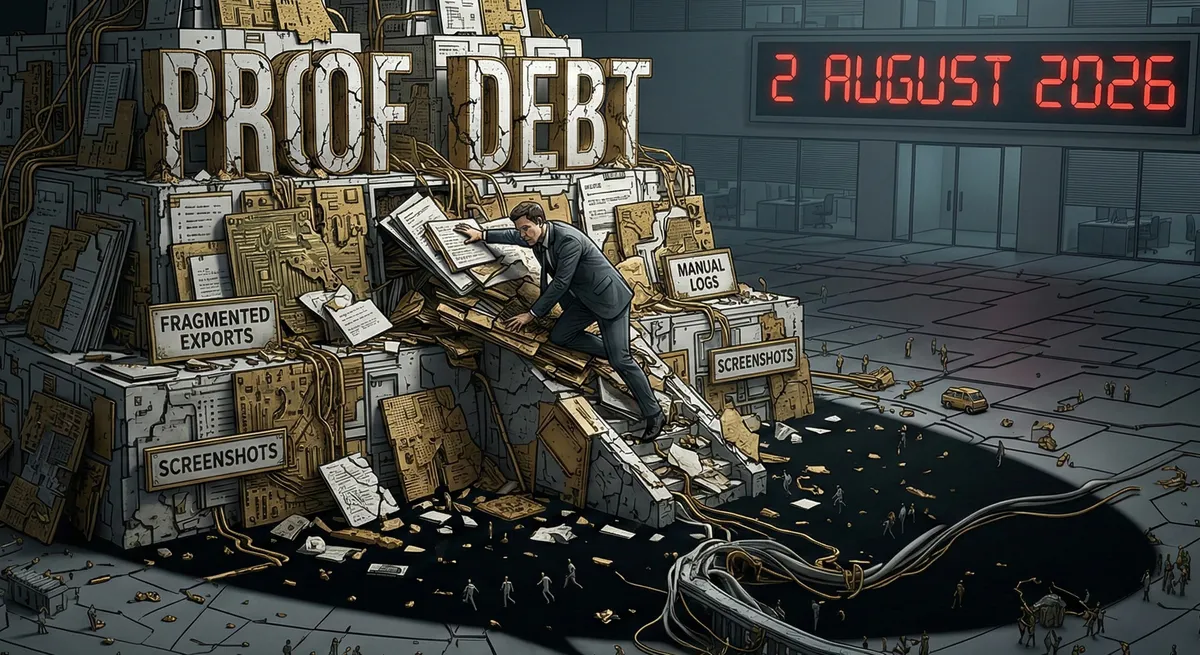
It is creating a proof debt deadline.
As of 25 February 2026, the AI Act’s main application date of 2 August 2026 is close, and the organisations that still rely on fragmented screenshots, exports, and local notes for high impact decisions are about to feel that pain in legal, compliance, operations, and procurement at the same time. :contentReference[oaicite:8]{index=8}
Why this hits insurance specifically
This is not theoretical.
The Commission’s own AI Act guidance explicitly lists risk assessment and pricing in relation to natural persons in life and health insurance as high risk examples under Annex III. The AI Act Service Desk text also lists that insurance use case directly in Annex III point 5(c). :contentReference[oaicite:9]{index=9}
EIOPA has also been steadily signalling the direction of travel:
EIOPA published its Opinion on Artificial Intelligence governance and risk management in August 2025, addressed to national supervisors and clarifying key principles and requirements for the use and supervision of AI systems in insurance. :contentReference[oaicite:10]{index=10}
EIOPA reports that AI use is already widespread, with AI used by 50% of respondents in non-life insurance and 24% in life insurance, and usage expected to increase. :contentReference[oaicite:11]{index=11}
EIOPA’s consumer trends reporting notes AI can improve speed and navigation in claims, but also flags drawbacks such as limited consideration of individual circumstances and excessive standardisation in pricing, underwriting, and settlement processes. :contentReference[oaicite:12]{index=12}
DORA has already entered into application (17 January 2025), which adds pressure for stronger digital resilience and third party control discipline across financial entities, including insurers. :contentReference[oaicite:13]{index=13}
Put simply:
Insurers are using more AI.
Supervisors are clarifying expectations.
Consumers and counterparties are scrutinising outcomes harder.
The cost of weak records is rising.
The pain point buyers will actually pay to fix
Here is the big one.
It is not “AI bias” in the abstract.
It is decision-time proof under hostile review.
The most expensive moments in insurance are rarely when the decision is made.
They are when the decision is challenged.
The challenge usually arrives later
A claimant disputes a denial
An ombuds review starts
A reinsurer questions recoverability
A delegated authority chain is audited
A reserve or settlement override is escalated
Counsel asks what was known at the time
A regulator asks how the AI-supported action was governed
At that point, most teams discover the same thing:
They do not have one portable, defensible proof surface.
They have a reconstruction exercise.
That is the proof debt.
What the EU AI Act changes for deployers
The AI Act does not just regulate providers. It also creates obligations for deployers of high risk AI systems.
That matters for insurers, because even where a vendor provides the model, the insurer still owns the operational reliance.
Article 26 is the practical centre of gravity here. It requires deployers of high risk AI systems to:
use systems according to instructions
assign human oversight with competence, training, and authority
monitor operation and escalate risks
keep automatically generated logs (where under deployer control) for at least six months, unless other laws apply
inform affected persons in relevant decision contexts
cooperate with competent authorities
It also specifically notes that for financial institutions, certain monitoring and log obligations can be fulfilled through existing internal governance and documentation requirements under EU financial services law. That is important because buyers want integration, not duplicate process. :contentReference[oaicite:14]{index=14}
Then Article 86 adds a right to clear and meaningful explanation for affected persons in certain high risk AI-supported decisions with legal or similarly significant effects. In buyer terms, this means your explanation workflow is only as good as your evidence discipline. :contentReference[oaicite:15]{index=15}
And if you are in a lane that triggers broader rights impact concerns or public-service style use contexts, Article 27 raises the bar again through fundamental rights impact assessment requirements in specific high risk cases. :contentReference[oaicite:16]{index=16}
The commercial mistake insurers are about to make
Many teams will respond by producing more documents.
That helps a bit.
But it does not solve the real operating problem.
Because the issue is not just having documents.
The issue is controlling reliance.
Can a downstream team, reinsurer, auditor, ombuds handler, or legal reviewer verify whether a decision is still valid to rely on right now?
If your answer is “we need to log into three systems and rebuild the timeline,” that is not a control.
That is future cost.
Where Good Proof(TM) creates immediate value in insurance
Good Proof(TM) does not replace claim systems, fraud tooling, underwriting systems, or vendor models.
It sits where the liability sits.
At the point of reliance.
The simple framing buyers understand
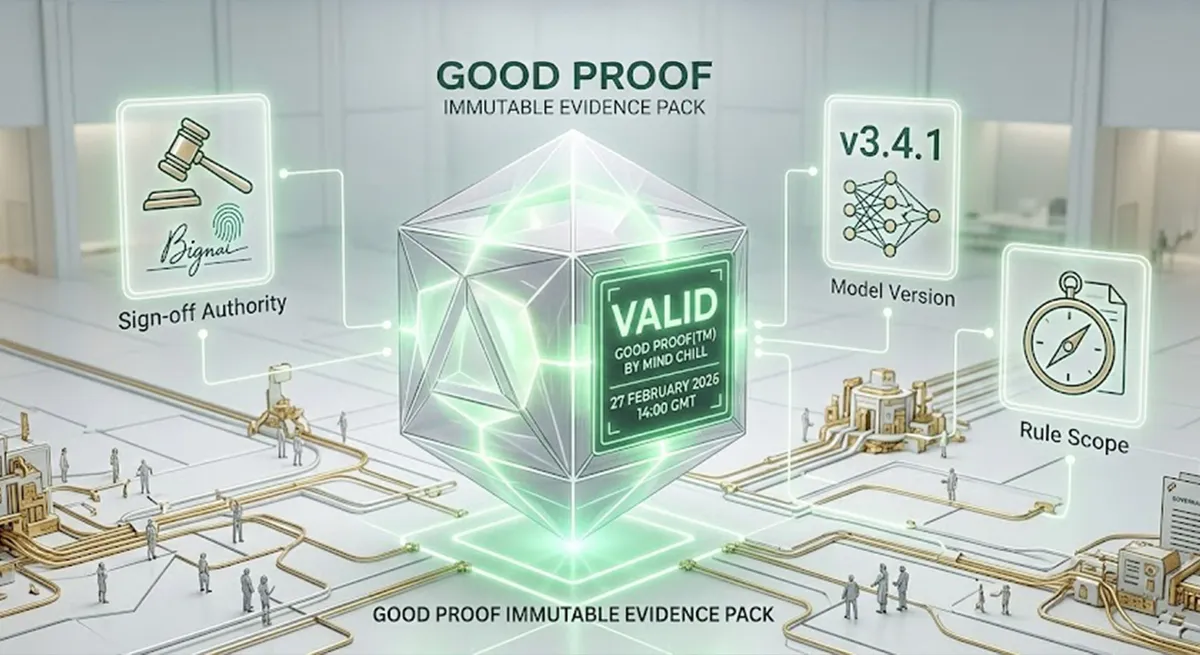
Good Proof(TM) is a reliance control layer for high-impact insurance actions.
It gives teams a way to prove:
what action was taken
what scope it was valid for
who signed or approved it
what the validity state is now
what existed at decision time
what changed later
That is why it works commercially for claims, legal, SIU, compliance, procurement, reinsurance, and resilience teams at the same time.
The insurance pain points it solves best
1) Claims and dispute defensibility
When a denial, settlement, or closure is challenged later, Good Proof(TM) gives a Status Link for current reliance state and an IDA Evidence Pack for the decision-time record.
That reduces “rebuild the record” cycles.
2) Delegated authority and multi-party reliance
MGA, TPA, coverholder, carrier, and reinsurer chains create a portable proof problem.
Good Proof(TM) gives counterparties a verifiable link without forcing them into your internal case systems.
3) Model and policy drift
Rules change. Vendors change. Policies are updated. Thresholds move.
Good Proof(TM) introduces machine-checkable state changes like:
NEEDS_REFRESH
WITHDRAWN
That turns silent drift into visible operational control.
4) Legal and ombuds response cost
Most teams are not short of data. They are short of usable evidence.
Good Proof(TM) packages a minimal-disclosure, dispute-ready evidence surface that legal and review teams can use without exposing every payload by default.
5) Procurement and vendor governance
Insurers increasingly need contract language that works in reality, not just policy language.
Good Proof(TM) supports clause-ready semantics that procurement and vendor governance teams can actually enforce:
valid
refresh required
withdrawn
not verified
Why budget owners will say yes
The strongest Good Proof(TM) insurance pitch is not “buy an AI governance tool.”
It is:
Reduce existing costs that already hurt.
That means Good Proof(TM) fits into budgets buyers already control:
Claims Operations
Reduces repeat investigation and rework costs in adverse decision reviews.
Legal and Disputes
Cuts reconstruction time when cases escalate.
SIU / Fraud Governance
Makes fraud flags and hardship-impacting holds defensible at decision time.
Compliance and Risk
Provides portable evidence for governance reviews and supervisory scrutiny.
Reinsurance / Recoverability
Improves decision-time traceability across cedant and reinsurer review.
Procurement / Vendor Risk
Adds machine-checkable reliance semantics to vendor terms and delegated authority workflows.
Security / Resilience
Supports fail-closed handling and cleaner blast-radius control when defects or integrity issues appear.
This is why the category is buyable now.
It removes pain buyers already pay for.
What makes this timely in the EU, not just globally
The EU is not just adding AI rules.
It is creating a practical expectation that high impact AI use is:
governed
monitored
reviewable
explainable
and auditable over time
The AI Act requirements on record keeping, deployer monitoring, post market monitoring, serious incident handling, and rights to explanation all point in the same direction. EIOPA’s guidance and market signals point the same way for insurers. DORA increases the pressure for robust digital and third party controls across the operating environment. :contentReference[oaicite:17]{index=17}
That is exactly why Good Proof(TM) lands now.
It is not another model.
It is the missing proof layer between AI output and insured outcome.
A line your buyers will remember
You need one line in the article that does the work.
Use this:
EU insurers do not mainly need more AI. They need proof that the last high-impact AI-supported decision was valid, in scope, and defensible when it mattered.
That is the category.
That is the pain.
That is the budget.
Suggested internal links for conversion
Buyer paths
Claims Buyer Guide
Legal / Disputes Buyer Guide
Compliance Buyer Guide
Procurement Buyer Guide
Risk Buyer Guide
SIU / Fraud Governance Buyer Guide
Reinsurance Buyer Guide
Technical and due diligence paths
Insurance Sector Overview
Verify API
Stamp Spec
Specimen Status Link
IDA Evidence Pack Spec
Clause Pack
Book an Insurance Stamp Sprint
Final thought
A lot of insurance AI conversations still sound like innovation theatre.
The buyers who matter are past that.
They are asking a harder question now:
When this decision gets challenged later, what can we prove without scrambling?
Good Proof(TM) is built for that question.
And in the EU, that question is no longer optional.
Good Proof(TM) resources for technical and buyer review
For teams evaluating this category now, the next step should feel like due diligence, not a leap of faith.
Buyer paths
Claims buyer guide
Compliance buyer guide
Procurement buyer guide
Risk buyer guide
Legal / disputes buyer guide
SIU / fraud governance buyer guide
Reinsurance buyer guide
Technical paths
Insurance sector overview
Verify API
Stamp spec
Specimen Status Link
IDA Evidence Pack spec
Clause pack
Book an Insurance Stamp Sprint
Not legal advice. Good Proof(TM) is not a certification. It is a scope-limited verification and reliance control layer.