No Stamp → No Ship
High-impact actions should not change someone's life without a Good Proof Stamp.
Cryptography proves the receipt.Good Proof proves the reliance state.
Good Proof does not ask you to trust the AI. It gives your systems a live, external reliance check before the AI is allowed to act.
Status Link (live validity) · IDA Evidence Pack (snapshot) · Scope-bound · Expiry-aware · Revocable
VALID
→ proceed
NEEDS REFRESH
→ block until re-verified
WITHDRAWN
→ stop relying
NOT VERIFIED
→ fail-closed
MCP tool use • agentic commerce • money movement • robotics physical autonomyMCP • commerce • money • robotics
Mind Chill Guardians when a lane requires human finality.
Scope-limited verification. Not a certification. Acceptance depends on counterparty or programme requirements.
Regulatory
 EUEU AI Act enforcement begins — high-risk AI systems now require conformity assessmentsFeb 2025│
 UKUK publishes AI Safety Institute guidance on frontier model evaluations2025│
 USANIST AI 600-1 released — GenAI risk profiles now standardised2024│
 APACSingapore MAS issues advisory on AI-driven financial decision accountability2025│
 AFRICASouth Africa POPIA enforcement targets automated decision-making systems2025│
 MIDDLE EASTUAE ADGM publishes responsible AI framework for financial services2025│EUEU AI Act enforcement begins — high-risk AI systems now require conformity assessmentsFeb 2025│UKUK publishes AI Safety Institute guidance on frontier model evaluations2025│USANIST AI 600-1 released — GenAI risk profiles now standardised2024│APACSingapore MAS issues advisory on AI-driven financial decision accountability2025│AFRICASouth Africa POPIA enforcement targets automated decision-making systems2025│MIDDLE EASTUAE ADGM publishes responsible AI framework for financial services2025│
Choose your high-impact lane
Start with the decision type you need to defend. Open sector examples or pre-fill a Sprint request.
Claims & Disputes
Insurance claims, hardship, eligibility
Deactivations
Platform bans, account closures

Duty of Care
Prior auth, healthcare, travel safety

Money Movement
Transfers, payouts, refunds
Hiring & Screening
Background checks, adverse actions

Agentic Actions
Tool use, approvals, irreversible actions
RegTech Decision Integrity
Policy-bound verification for regulated workflows
Security Automation
Fail-closed controls for automated security testing
Top lanes shown here. Full sector coverage below.
Engine-agnostic trust rail·Standalone from day one
·Integrate external accountability engines
Proof you can forward internally

Founder's Note
Why we built Good Proof
High impact decisions do not stay internal.
They get challenged later by auditors, regulators, counterparties, and the public.
When liability lands on a person or institution, "the system decided" will not survive.
Good Proof turns "trust us" into "check it."
Authoritative now
A Status Link that updates when conditions change.
Fileable then
An IDA Evidence Pack for procurement and disputes.
Human when required
Mind Chill Guardians for edge cases.

"We built products used by millions, then watched 'trust us' fail when decisions were challenged."
— Jamie (Mind Chill) + the Mind Chill Guardians
LinkedIn•17,225+ followers
 The Problem
Why automations fail in the real world
AI fails when workflows are vague and oversized. Good Proof breaks high-impact autonomy into defined decision classes.
01
Context
Scope boundaries. Evidence windows.
02
Logic
Refresh rules. Withdraw triggers.
03
Duty-of-care
Human finality when required.
Honest by design
What Good Proof does not claim
Good Proof does not claim an AI action is perfectly true, permanently safe, or impossible to manipulate. AI models change. Prompts drift. Tools fail. Context can be incomplete. Prompt injection can manipulate agents. Evidence can become stale. Good Proof exists because of that.
Verifiable
Cryptographically anchored. Independently checkable.
Scope-stated
Bound to a defined action class and programme scope.
Time-bound
Expiry-aware, refresh-aware, revocable on change.
Good Proof proves whether a high-impact action was authorised, scoped, evidenced, current, revocable, and safe enough to rely on at the point of consequence.

A Status Link you can actually rely on.
Most governance fails when proof needs to travel. A Good Proof Stamp gives you a single Status Link that survives:
Disputes
A defensible audit trail.
Procurement
Proof that travels outside your perimeter.
Agentic Security
Structural constraints beat prompts.
Stamp ID
A reference your contracts, tickets, and UIs can cite.
Status Link
The authoritative, auditable source of current validity within scope.
Refresh / Withdrawal
Append-only versioning. When conditions change, status changes—history remains.
verify.goodproof.mindchill.ai response
Default verify response fields
statusVALID / NEEDS REFRESH / WITHDRAWN / NOT VERIFIEDscopeAction class and boundariesexpires_atValidity windowverified_atTimestamp of verificationsignerSigning authority referenceNo portal. No system login. Verification happens at verify.goodproof.mindchill.ai and fails closed by default.
Don't trust links. Type mindchill.ai/official to verify.
Excluded by default: prompts, logs, PII, internal identifiers. Programme-gated access available for authorised verifiers.
How it works
Stamp → Status Link → Verify.That's the whole standard.
Define high-impact action classes
Hardship, eligibility, irreversible actions, overrides, high-value transfers. Material-change triggers + evidence windows.
Require a Stamp
No Stamp (or NOT VERIFIED / NEEDS REFRESH) → block or escalate. Fail-closed by design.
Counterparties verify by link
They check status + scope + expiry without needing your internal systems. Signed responses available.
Guardians step in when required
Edge cases, exceptions, disputes—scoped human finality with anti-rubber-stamp controls.
You don't buy another dashboard. You buy a contract-ready gate that makes high-impact autonomy shippable.

Live Status States
Fail-closed verification states for high-impact decisions
VALID
→ proceed
NEEDS REFRESH
→ block until re-verified
WITHDRAWN
→ stop relying
NOT VERIFIED
→ fail-closed
VALID = valid within scope under lane rules. Not a guarantee of outcome correctness.

Trust Model
Structural constraints, not trust assumptions.
Fail-closed
Unreachable = NOT VERIFIED.
Minimal disclosure
Prompts, logs, PII excluded by default.
Signed responses
Programme-scoped cryptographic verification.

Agentic AI safety
When AI executes tools, the gate must be verifiable — and revocable in seconds.
No Stamp → No Ship · Fail-closed · Machine-checkable
Enforceable gate path
01
Action attempts
Agent triggers gated action
02
Gate checks
Status Link verified
03
VALID → proceed
Within scope, execute
04
WITHDRAWN → block
Revoked at source
Gate response
status:"VALID"
scope:"tool_execution:high_impact"
expires_at:"2026-06-15T00:00:00Z"
verified_at:"2026-01-08T14:32:00Z"
Fail-closed: unreachable = NOT VERIFIED → block or escalate
Interoperability
Works with runtime accountability engines.
Works without them too.
Good Proof can run as your primary verification layer or ingest evidence from external runtime engines. We normalize evidence into procurement-ready reliance.
Common Evidence Schema
Normalized fields for status, scope, signer, evidence window, and trace references.
Adapter Interface
Integrate external engines through a stable adapter contract.
Conformance Tests
Verify consistency before relying on integrated evidence.
Portability and Customer Control
Exportable records and verifier portability reduce lock-in risk.
Federated Trust
Independent witnesses and quorum by risk lane
High-risk reliance should not depend on a single party. Good Proof supports independent witness models and quorum policies.

Independent Witnesses
Multiple verifiers can attest to the same evidence, removing single-party dependency.
Quorum by Risk Class
Higher-risk lanes can require multiple confirmations before reliance proceeds.
Conflict Handling
When witnesses disagree, escalation rules determine resolution path.
Tamper-Evident Event Trail
Every attestation, withdrawal, and status change is logged immutably.
Good Proof is scope-limited verification, not blanket certification.
Verify API
Verify Stamps at scale: status lookups, webhooks, access requests, signed responses (programme-scoped).
Forwardable to Legal & Procurement
Procurement Kit
Everything your legal and procurement teams need.
PDFs for filing · Status Links stay current · One email to forward
IDA Specimens
Stamped & redacted evidence packs
Contract Clauses
Pre-negotiated clause language
Kill Switch
Instant revocation flows
Verify API
Machine-readable status
IDA Evidence Pack
Stamped & Verified
stamp_id:████████
issued_at:████████
decision_class:████████
evidence_window:████████
VALID
Forwardable


Mind Chill Guardians(only when required)
Programme-authorised human finality for the edge cases.
Conflict-checked · Rotation-based · Audit-traceable
Conflict rules Rotation
 Multi-review
Why Mind Chill exists
AI is learning from clicks. Good Proof forces decisions to prove what they're based on, without dumping sensitive data.
AGI won't save us.
It knows what we click on, not what we care about.
Jamie, Mind Chill
Large models absorbed the open internet: genius and grief, but also scams, outrage, and performance. When the inputs get synthetic, the outputs don't just get wrong — they get confidently wrong.
What we do about it: scope-bound verification + fail-closed gates for high-impact actions.
Good Proof is the gate. Mind Chill is the human layer behind it: lived experience that makes the standard real.
One standard gate. Every sector.
High-impact action classes defined by lane. Material-change triggers + evidence windows.
Hardship / Duty of Care
Life-impact decisions with evidence windows
Irreversible Actions
Closures, bans, disconnects, denials—appealable by link

Insurance / Disputes
Evidence that survives hostile review
Incident Closure
Board / insurer / regulator scrutiny with audit trail
Procurement Claims
Vendor assurance without oversharing. Minimal disclosure.
Agent Permissions
Scope-bound authority. Short-lived. Revocable.
Example high-impact action classes (lanes)
Hardship determinationsEligibility decisionsHigh-value transfers (>threshold)Account closures / bansOverride approvalsClaims adjudicationBatch release exception / disposition
Same gate. Same Status Link. Different lane.
Who Buys a Good Proof Stamp?
Different roles, same need: verifiable gates for high-impact AI actions.


Start where decisions get challenged.
High-impact AI decisions exist in every industry. Live status makes them verifiable.

Featured
Claims & Disputes
Insurance
If a claim decision can't survive a dispute, it isn't shippable.

DvP & Custody
Finance
No Stamp → No Ship for money movement + tokenised settlement.

Irreversible Actions
Platforms
Bans/closures require an appealable Status Link.

Duty of Care
Healthcare
Ops decisions need scoped human finality.

Eligibility & Appeals
Government
Appealable decisions by link.

Quality + Patient Safety
Pharma
Validated change, batch release, and safety triage you can defend.

Hiring & Screening
HR
High-impact screening decisions you can defend.

Also used for protocols & rails
MCP tool use • Agentic commerce (UCP) • AI ad integrity • Voice & wearables integrity • Tokenised settlement • Quantum readiness
See Protocols & RailsStart with one lane
30-day Stamp Sprint → prove it works → expand when counterparties rely on the Status Link.
Frequently Asked Questions
Questions a sceptical buyer, competitor, or regulator would ask.
Stamped IDA Evidence Packs (Redacted)
See what a Stamp looks like in production—without the sensitive data.
Some programmes show a "Ledger-anchored" badge with a reference link for change events.
OUR MOAT
We Care Defensibly

A Global Human Layer
Our Mind Chill Guardian Story
A global human layer that software can't fake.
When liability lands on a person, the sign-off should too.
Conflict-checked · Rotation-based · Audit-traceable · Programme-scoped
From calming minds to defending outcomes
Mind Chill began in 2017 as immersive art built to reduce anxiety and create calm at scale. Then the same feeds that buried calm and rewarded outrage started training the systems that now make real decisions. We didn't want more rhetoric. We wanted receipts.
The moment it clicked
A message arrived: someone's child felt safer because of what they experienced. Around the same time, lived experience inside our own community made one thing obvious: the nuance that matters in high-impact decisions can't be reliably reduced to a prompt. So we designed a human layer for the edge cases—structured, scope-bound, and auditable.

Guardians are not a "panel." They're a network.
Mind Chill Guardians come from different countries, backgrounds, and lived realities. That diversity is not branding—it's risk reduction. It makes decisions harder to game, easier to challenge, and more credible under scrutiny. Guardians do not "run the system." They review only what the lane requires humans to own.
Receipts over rhetoric
Operational Guardians plug into Good Proof lanes as a controlled finality mechanism: conflict checks, rotation, multi-review where required, and an audit trace tied to a Status Link. Minimal disclosure by default. If a decision is appealed months later, you can show what happened, within scope, without dumping sensitive payloads.
Why buyers choose Guardians
Lived experience at the edge cases (not a generic helpdesk)
Conflict-checked + rotation-based (anti-rubber-stamp by design)
Multi-review on high-risk lanes (when the programme requires it)
Audit-traceable outcomes (defensible in disputes, audits, procurement)
Minimal disclosure by default (proof, not payloads)
Not a certification. Scope-limited verification. Acceptance depends on counterparty/programme requirements.
Latest Updates
Today's Featured News
The latest on AI verification, regulatory developments, and how organisations are building trust into high-impact systems.
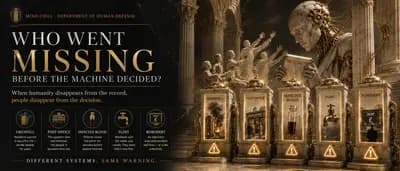 Official
General2 Jul 2026
Who Went Missing Before the Machine Decided?
After being invited to contribute to Earth05 & SUMMIT 333 AI Safety, Jamie (Mind Chill Guardian 01) explains how Representational Care and Absence Audit became the next public phase of Mind Chill: making missing human context visible before AI-enabled decisions harden into power.
Read more

Agentic AI16 Apr 2026
Better AI Will Create Better Mistakes. That Is Good News for Good Proof.
Claude Opus 4.7 is not bad news for Good Proof. It is the market admitting the real problem has moved. Once models get good enough to act with confidence, the expensive part is no longer generating the answer. It is defending the outcome, handling the dispute, containing the blast radius, and avoiding weeks of rework when the machine was confidently wrong. That is where Good Proof starts.
Read more

Regulatory23 Mar 2026
The Boardroom Trap in AI Governance | Good Proof™
The EU AI Act is not a distant compliance story. Its staged rollout is already changing what boards need to know, prove, and control. By August 2026, the winners will not be the companies with the best AI principles slide. They will be the ones that can show evidence of control.
Read more
Make high-impact AI shippable.
Define your high-impact action classes. Require the Stamp. Let the Status Link do the rest.