Good Proof by Mind Chill·25 February 2026·8 min read
Most public-sector AI failures do not begin in the model. They begin when procurement cannot prove what was approved, by whom, for what scope, and whether reliance was still valid when the complaint arrived.
The Most Expensive Part of Government AI Is Not the Model
Most public-sector AI debates are framed like philosophy.
Bias. Ethics. Principles. Governance.
All important.
But when things go wrong in the real world, the expensive question is usually much less philosophical:
What exactly was approved, by whom, for what scope, and can you still prove it now?
That is not mainly a model-risk question.
It is a procurement-to-litigation evidence chain question.
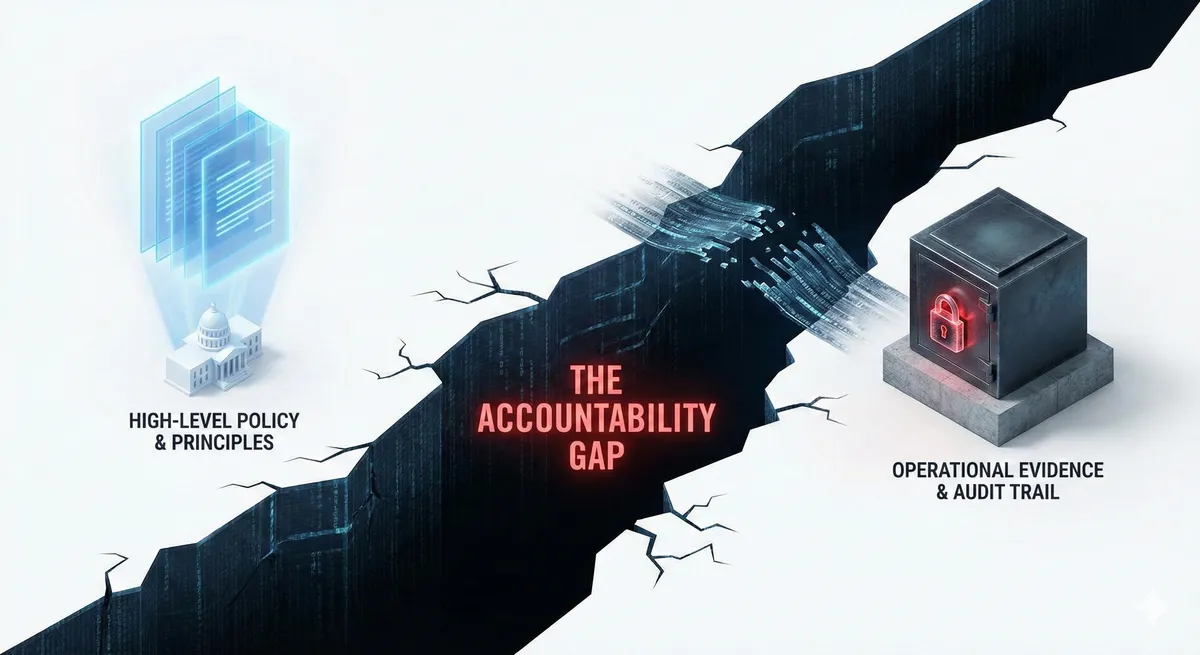
And right now, that is where the gap sits.
This Is Already the Operating Environment
Government is moving from broad principles to enforceable expectations.
AI policy is moving from principles to accountable use cases
The policy environment is now explicit about use-case governance, designated accountability, and risk-based actions at the programme level.
The implication is straightforward:
If a high-impact AI-supported action is challenged, agencies must be able to show how governance translated into operational control.
Technical standards are demanding auditability, not just documentation
Technical standards have moved beyond "have a policy" and into "show end-to-end auditability."
In plain English:
Agencies are being told to build systems that can survive scrutiny, not just launch.
The Hidden Problem Is Proof Portability
Most agencies and vendors can produce something after an incident:
a dashboard screenshot
a PDF export
a policy memo
a committee minute
a vendor explanation
That is not the same as a portable, decision-time proof trail.
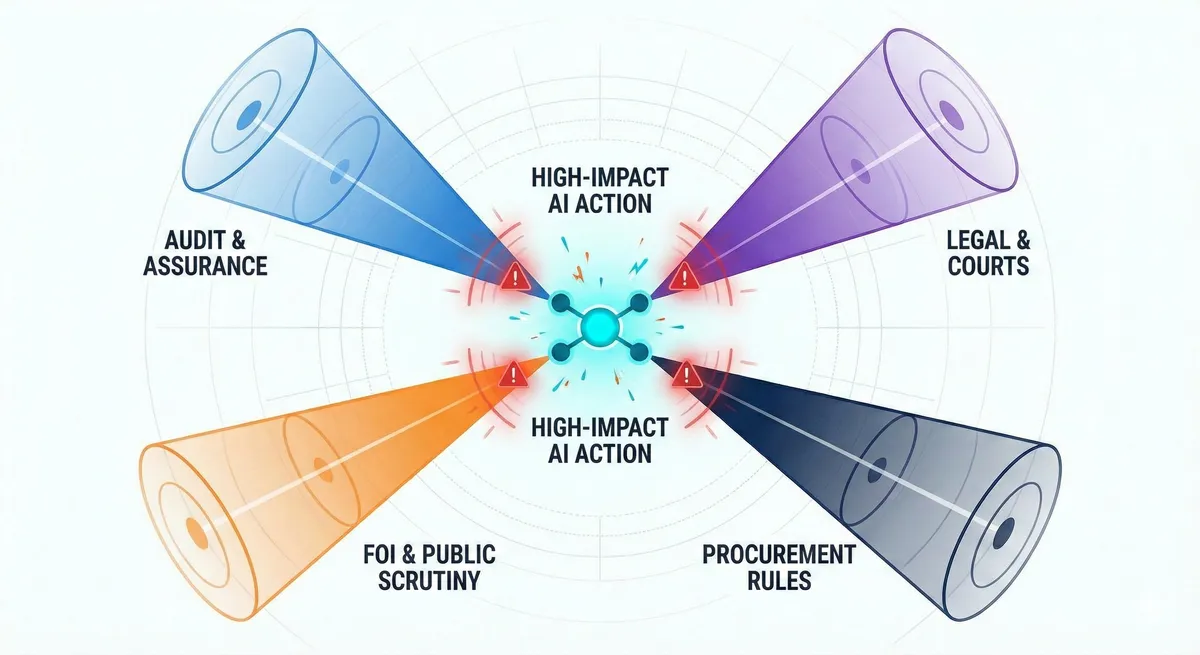
Because the moment a high-impact AI-supported action is challenged, the review rarely stays inside one system.
It crosses:
procurement
legal and public law
policy
risk and assurance
audit
privacy and information governance
external oversight and counterparties
The evidence has to travel.
If it cannot travel, teams rebuild the record by hand.
That is where time goes.
That is where trust goes.
That is where budgets go.
Procurement Is Being Upgraded, Not Simplified
Government procurement expectations are evolving quickly, and that evolution is directly tied to how AI systems will be governed in practice.
Procurement rules are tightening around evidence and defensibility
Procurement teams are actively rewriting how they buy and how they evidence value, risk, and control.
This matters because it changes what buyers can require up front.
AI model clauses help, but clauses are only the start
Government AI model clauses exist, and they are an important signal.
But a clause is still a promise until an agency has an operational mechanism that can prove the clause is being followed for real actions in real time.
In other words:
Contract language without machine-checkable enforcement becomes expensive later.
Transparency and Scrutiny Are Rising Faster Than Readiness
Government AI risk is increasingly driven by disclosure pressure.
If agencies cannot show what automated decision-making exists, what it does, and how it is governed, the accountability tail expands:
more FOI friction
more complaint escalation
more external scrutiny
more remediation work
more "rebuild it from scratch" cycles
Audit and Courts Are Already Adapting
Oversight is moving from theory to evidence testing.
Audit offices are explicitly building capability to test AI tools and processes more deeply in practice.
Courts are issuing and reviewing practice notes and guidance as the legal system adapts to the operational reality of AI use.
Legal scrutiny infrastructure is not hypothetical.
It is already being built.
This is why "show me the decision trail" becomes a budget line, not a talking point.
A Simple Scenario That Creates a Very Expensive Problem
An agency uses an AI-supported risk signal to trigger an eligibility hold, referral, escalation, restriction, or case closure.
At the time, it looks reasonable.
Months later, a complaint lands.
Now the agency has to prove:
which action class was approved
what scope and thresholds applied
which policy and clause set governed this use case
what was relied on at decision time
who had authority to approve that reliance
whether anything changed later that should have triggered refresh or withdrawal
how the agency can evidence this without pulling internal systems apart
Without a portable proof layer, this becomes a cross-team reconstruction exercise.
With a portable proof layer, it becomes a review.
That difference is where cost disappears.
This Is Where Good Proof™ Wins
Good Proof™ is not another AI policy document.
It is not another dashboard.
It is not a vague "assurance layer."
It is a reliance control system for high-impact actions.
Public-sector AI failures rarely happen when a model is being demoed.
They happen when an action is taken, the context changes, and nobody can prove what was valid at the time.
What Good Proof™ Changes in Practice
For any defined high-impact action class (for example, eligibility decisions, referral triggers, enforcement escalations, benefit holds, permit restrictions, case closures), Good Proof™ creates a verification trail that is:
Scope-bound
Valid only for the defined action class and programme scope.
Status-based
Returns a live validity state: VALID, NEEDS_REFRESH, WITHDRAWN, NOT_VERIFIED.
Portable
Reviewers can verify by link without needing internal system access.
Dispute-ready
A time-stamped Evidence Pack can be filed for audit, complaint handling, internal review, FOI workflows, and external scrutiny.
Fail-closed
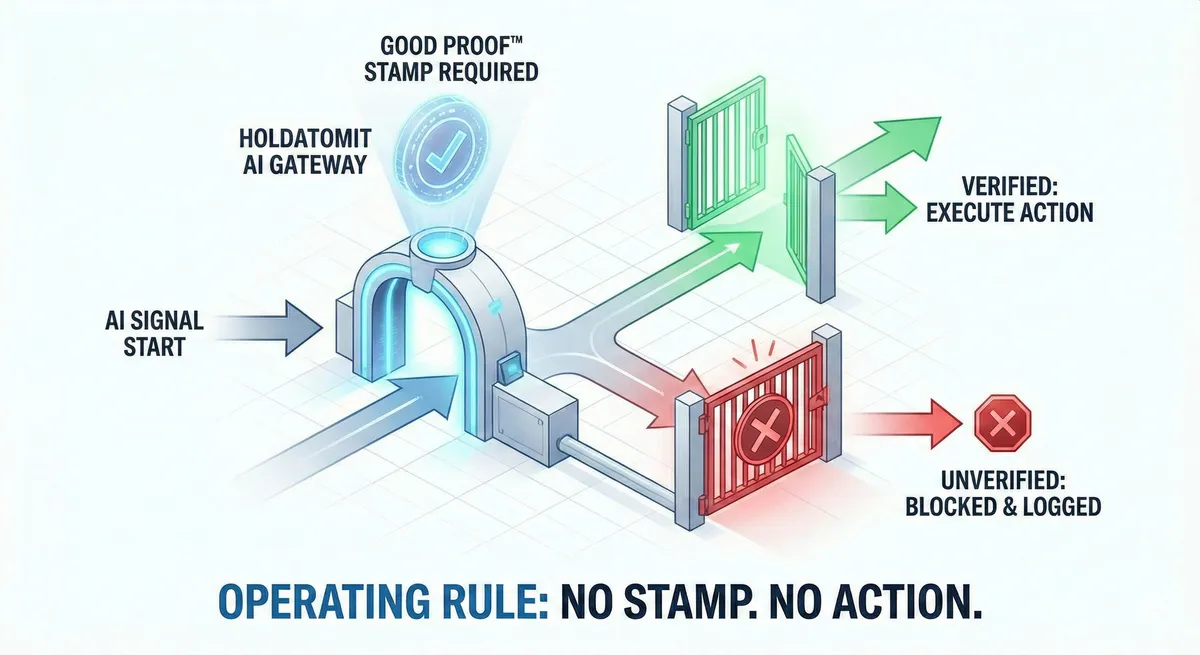
If verification cannot be completed, the action is treated as unverified. No silent assumptions.
This is the missing operational bridge between:
AI policy
procurement clauses
frontline decisioning
legal defensibility
Why This Is a Procurement Story First
The biggest AI risk cost in government is often not the model.
It is the admin cost of uncertainty after the model has already acted.
That cost shows up as:
repeated internal reviews
FOI and complaint handling friction
legal reconstruction work
audit remediation
cross-agency blame loops
vendor ambiguity
policy controls that operations cannot actually enforce
Procurement is where this gets fixed early.
Because procurement is where agencies can require:
defined high-impact action classes
machine-checkable verification states
refresh and withdrawal triggers
evidence retention rules
counterparty verification rights
exception paths with named accountability
acceptance criteria that test proof portability, not just model output
This is exactly where Good Proof™ becomes commercially valuable.
It gives buyers something they can actually buy:
a machine-checkable operating rule for high-impact AI-supported actions.
Not a promise. Not a posture. A control.
Who Should Care First Inside Government
This is not just for "the AI team."
The strongest internal champions are usually:
Procurement and Commercial
Contract terms that can be enforced operationally, not just negotiated beautifully.
Legal and Public Law
Decision-time evidence that survives complaints, review, and litigation pressure.
Risk, Integrity and Assurance
Demonstrable control effectiveness, not slideware.
CIO, CISO, Digital, AI Governance
A deployment path that supports AI adoption without creating an accountability tail.
FOI, Privacy, Information Governance
Reviewability without defaulting to raw payload disclosure.
Where Budget Comes From
Good Proof™ usually fits existing budgets.
It does not require a new category.
Typical funding paths include:
procurement uplift and contract remediation
audit and assurance uplift
legal risk reduction
complaints and review handling efficiency
programme governance and controls uplift
AI deployment controls for high-impact use cases
This is a demand problem because agencies already pay the cost every time a high-impact decision is challenged and the record has to be rebuilt from scratch.
A Better Operating Rule for Government AI
Policy signals are here.
Now buyers need an operational standard they can enforce.
A practical rule looks like this:
No high-impact AI-supported action should execute without a scope-bound, verifiable, refreshable, dispute-ready proof trail.
Or, in Good Proof™ language:
No Stamp. No Action.
What This Looks Like in Practice
Imagine an agency uses an AI-supported risk signal to trigger a referral, hold, escalation, or restriction.
Under a Good Proof™ operating model:
The action class is defined
Scope is explicit. An eligibility hold is not the same as an enforcement escalation.
A Stamp is required before execution
If status is not VALID, the action is blocked or escalated through the approved exception path.
The action carries a Status Link
Internal reviewers, procurement teams, auditors, and authorised counterparties can verify current reliance state.
If conditions change
Status moves to NEEDS_REFRESH or WITHDRAWN, and downstream reliance stops or re-verifies.
If challenged later
The Evidence Pack provides a time-stamped, scope-bound record of what was relied on at decision time.
That is what responsible AI looks like when it is designed for reality, not just policy decks.
Good Proof™ Resources for Buyer and Technical Review
For teams evaluating this category now, the next step should feel like due diligence.
Buyer review paths
Government procurement buyer guide
Public law and disputes buyer guide
Risk and assurance buyer guide
CIO, CISO, AI governance buyer guide
FOI, privacy, information governance buyer guide
Programme and policy controls buyer guide
Technical and operating paths
Government sector overview
Verify API
Stamp specification
Specimen Status Link
Evidence Pack specification
Clause pack
Escalation path (optional)
DPIA support pack (programme-scoped)
Controls mapping note (programme-scoped)
Sources for editorial review
Policy for the responsible use of AI in government (v2.0 effective 15 December 2025)
AI Technical Standard: Statement 4 and auditability criteria
Commonwealth Procurement Rules changes effective 17 November 2025 and updated CPRs PDF
AGS Legal update No. 327 on Commonwealth AI model clauses and tailoring
OAIC report on automated decision-making and public reporting under FOI (January 2026)
ANAO performance audit: Governance of Artificial Intelligence at the Australian Taxation Office
Federal Court Notice to the Profession on generative AI use
NSW Supreme Court Practice Note SC GEN 23 Use of Generative AI