Jamie (Mind Chill) | Good Proof·2 July 2026·7 min read
After being invited to contribute to Earth05 & SUMMIT 333 AI Safety, Jamie (Mind Chill Guardian 01) explains how Representational Care and Absence Audit became the next public phase of Mind Chill: making missing human context visible before AI-enabled decisions harden into power.
Good Proof exists because trust is no longer enough.
Not in AI.
Not in finance.
Not in healthcare.
Not in government.
Not in any system where a machine can help make a decision, trigger an action, move money, affect a life, deny access, approve risk, shape reputation or quietly remove a human from the loop.
The old world could often get away with saying:
“Trust us.”
The AI world cannot.
The AI world needs receipts.
A few weeks ago, Jamie Goldblatt, Founder of Mind Chill AI and Mind Chill Guardian 01, was invited to speak and contribute to the Earth05 & SUMMIT 333 AI Safety summit.
That work sharpened a question sitting at the heart of Good Proof:
What has to be proven before an AI-assisted decision becomes trusted?
Not just what the system did.
Not just what the model said.
Not just what the dashboard showed.
But who, or what, was missing before the decision was allowed to matter.
Better AI will not remove the need for proof
A lot of people still talk about AI safety as if the main problem is that AI makes mistakes.
That is only half true.
The scarier version is that better AI may make better-looking mistakes.
Cleaner mistakes.
Faster mistakes.
More official mistakes.
Mistakes that arrive with confidence, formatting, authority and no obvious human fingerprints.
That is why Good Proof matters.
Because once AI becomes part of real-world decisions, the question is not simply:
Was the output impressive?
The question becomes:
Can we prove the right checks happened before anyone trusted it?
The internet recorded humanity badly
AI is being trained on a record of humanity that was never fair in the first place.
The internet did not capture humanity evenly.
It captured what performed.
Outrage. Reaction. Repetition. Fear. Status games. Tribal certainty. People shouting because shouting was rewarded.
Then we called that engagement.
Then we trained machines on it.
But the quieter human signals were often missing.
Care. Grief. Recovery. Local knowledge. Moral hesitation. Family memory. Creative instinct. Cultural context. The person who knew something was wrong before the dashboard did.
So when people talk about AI alignment, Mind Chill keeps coming back to something painfully simple:
The future cannot be aligned to humanity if humanity is missing from the record.
Good Proof turns that into an operational question:
What record proves humanity was still in the decision?
Ownership is not the whole question
Jamie’s contribution at SUMMIT 333 sat under one idea:
Ownership is not the whole question. Representation matters too.
Public access is not permission.
Engagement is not human value.
Viral does not mean important.
Loud does not mean representative.
A dataset can be legally accessible and still be morally incomplete.
A model can be well-trained and still be badly represented.
A system can be accurate in one sense and blind in the one sense that matters.
That is why Mind Chill proposed Representational Care.
A duty not only to protect data, but to ask whose voice, context, warning, grief, creativity or lived experience was never properly captured in the first place.
Because AI governance cannot only ask:
Who owns the training data?
It also has to ask:
Whose humanity went missing from it?
Good Proof takes that question downstream.
When AI is used in the real world, we need to know:
Whose context went missing before the decision was trusted?
Absence Audit is the missing receipt
Most AI oversight asks what the system did.
Good Proof asks what was checked before the system was trusted.
Who was not consulted?
Whose consent was unclear?
What appeal route disappeared?
What human escalation step was skipped?
What context did the machine never see?
Which affected person could no longer force their way back into the decision?
That is Absence Audit.
Not another ethics slogan.
Not a badge.
Not a “trust us” certificate.
A practical record of what was missing.
An Absence Record.
For Good Proof, this matters because AI systems will increasingly need more than logs.
They will need proof of context.
Proof of escalation.
Proof of consent.
Proof of human review.
Proof of what was checked.
Proof of what was not checked.
Proof of what remains unresolved.
Because AI power concentration may not arrive as a science-fiction villain pressing a red button.
It may arrive as an administrative system that quietly removes the human who would have said:
“Hang on. Who is missing here?”
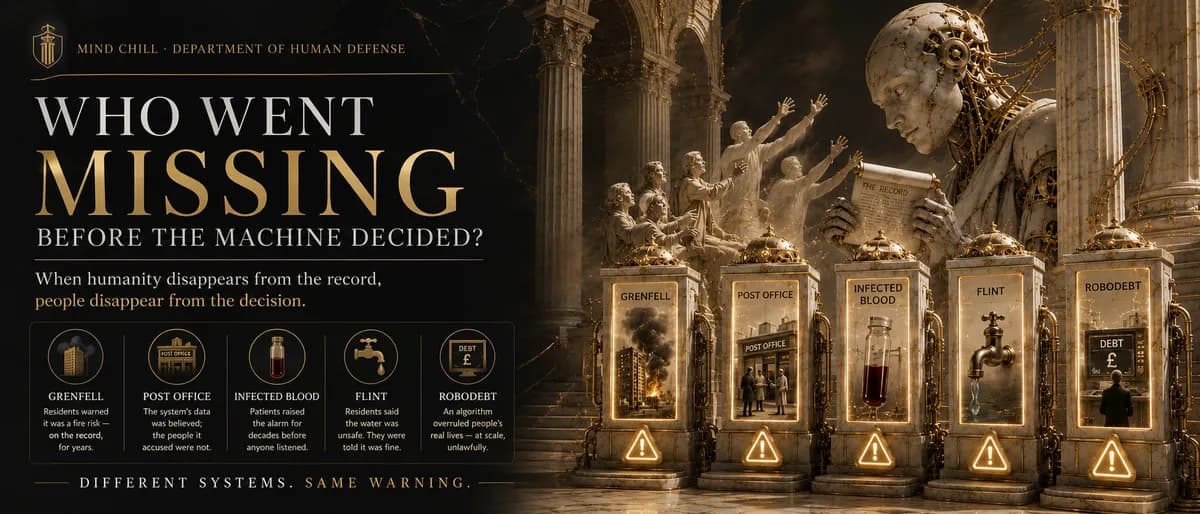
Same warning. Different systems.
Grenfell.
Post Office.
Infected Blood.
Flint.
Robodebt.
Different systems.
Same warning.
People raised alarms.
Records existed.
Warnings were ignored.
The system became more believable than the human being standing in front of it.
That is the danger Good Proof is built to confront.
Not just that systems make mistakes.
But that systems can make mistakes look official, scalable, objective and hard to challenge.
Bad systems used to need a lot of people to keep them moving.
AI may allow bad systems to move faster with fewer people in the loop.
That is not efficiency.
That is power concentration.
Friction is not always failure
Everyone hates friction.
Forms. Reviews. Appeals. Human sign-off. Waiting for someone to check. The awkward person in the room who says, “This does not feel right.”
But some friction is not inefficiency.
Some of it is civilisation.
Objection is friction.
Whistleblowing is friction.
Professional judgment is friction.
Local knowledge is friction.
A mother refusing to accept a decision about her child is friction.
A doctor overruling the system is friction.
A journalist asking the annoying question is friction.
AI promises to remove friction.
Good Proof asks a different question:
Which friction was actually protecting someone?
Because the irritating human delay may be the last defence against concentrated power becoming clean, fast and uncontestable.
No proof, no trust
This is where Good Proof becomes practical.
Before an AI-assisted decision, transaction, recommendation, verification or institutional action is trusted, there should be a clear record of what was checked.
Not a vague assurance.
Not a screenshot.
Not a policy PDF nobody reads.
A proof layer.
A status record.
A way to show:
Consent was checked.
Appeal routes were checked.
Escalation was checked.
Human review was checked.
Provenance was checked.
Affected stakeholders were considered.
Known unknowns were recorded.
That does not mean every system becomes perfect.
It means mistakes become easier to see, challenge and correct.
And that is a very different world from one where AI decisions simply arrive with authority and no one can reconstruct what happened.
From AI Safety to Good Proof
The summit did not create Mind Chill’s mission.
It sharpened it.
The work has already shaped the proposals and conversations Mind Chill and Good Proof are now having with companies, organisations, advisors and philanthropic funders.
It has sharpened Good Proof.
It has sharpened the Department of Human Defense.
It has sharpened Mind Chill AI Gold.
It has sharpened the Guardian work too, because Guardians were never just images.
They were always about official human record, proof, memory, signal and standing on the human side before the scramble.
The world is racing to build artificial intelligence.
Good Proof is focused on what has to be proven around it.
A verified human-signal layer.
A context layer.
A consent layer.
A record layer.
A “who disappeared?” layer.
Weights are not wisdom
There is a technical point here too.
Once a model is pre-trained, you cannot simply rewrite the original world it learned from.
The weights store what the model learned.
But they do not store what it should have learned.
That is why the layer around AI matters.
Post-training matters.
Retrieval matters.
Evaluation matters.
Red-teaming matters.
Audit matters.
Policy matters.
Deployment matters.
Proof matters.
Ownership governs the data.
Representation has to govern the model.
And accountability has to govern what the model is allowed to do in the real world.
Good Proof sits in that accountability layer.
Not asking people to blindly trust AI.
Helping organisations prove what happened before AI was allowed to matter.
The Good Proof direction
Good Proof is not anti-AI.
It is anti-unprovable AI.
It is anti-black-box authority.
It is anti-systems becoming more believable than the humans they affect.
Because when intelligence becomes artificial, one question becomes more important than ever:
What counts as proof that humanity was still in the room?
That is the work now.
To make absence visible.
To make human context harder to erase.
To make systems show their missing parts before they are trusted with power.
Because when humanity is missing from the record, people go missing from the decision.
And if people cannot see who disappeared from the decision, they cannot contest it.
That is why Good Proof matters.
That is why Mind Chill builds.
Jamie (Mind Chill)
Founder, Mind Chill AI
Mind Chill Guardian 01
Department of Human Defense
A Real Human