Good Proof by Jamie (Mind Chill)·27 February 2026·8 min read
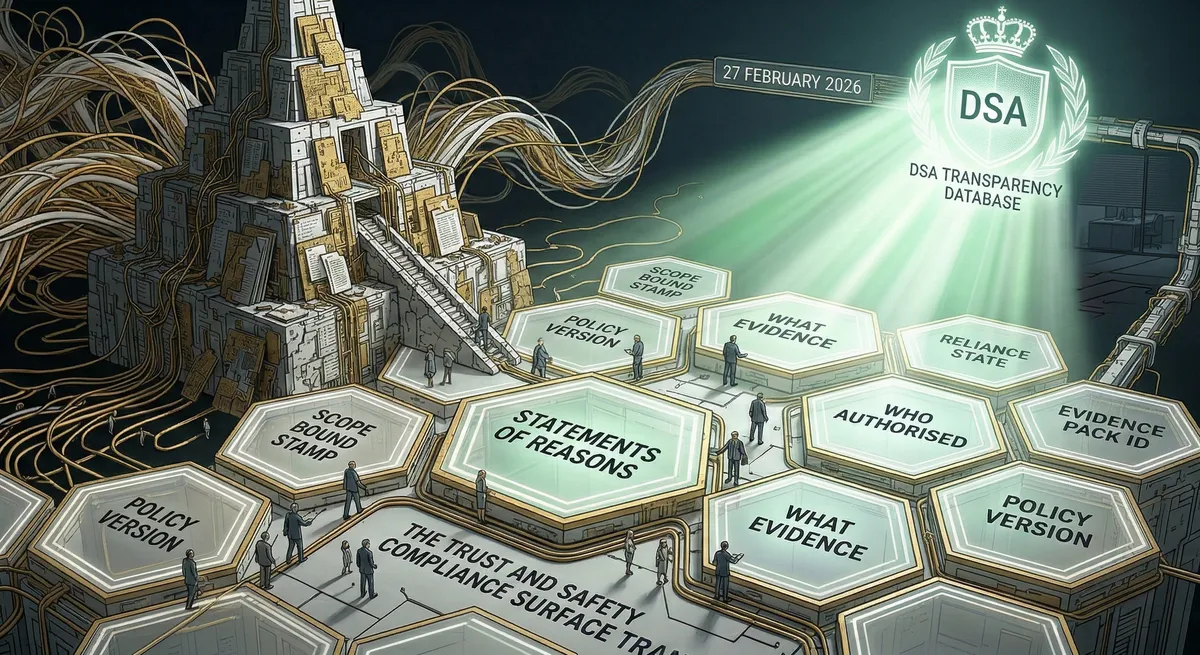
The EU DSA turned bans and restrictions into regulator-readable artifacts through Statements of Reasons and the DSA Transparency Database. That makes enforcement a proof problem: who authorised it, what was in scope, what was true then, and whether reliance should still stand today
The trap that burns teams: decisions outlive the context that created them
Most enforcement stacks are built to decide fast.
They are not built to answer:
Is it still valid to rely on this decision today?
That is where the expensive failures happen:
a restriction remains in force after a policy change
appeal context arrives but doesn’t propagate cleanly
a region updates interpretation guidance
detection behaviour shifts
a high-risk category is reclassified
new evidence changes proportionality
If you cannot make “stop relying” a first-class control, you get the worst outcome:
A decision that was reasonable becomes indefensible over time.
Where Good Proof™ wins for Trust and Safety
Good Proof™ is not a moderation engine.
It doesn’t replace your classifiers, enforcement tooling, queues, or case management.
It sits above high-impact restriction actions and adds the missing layer: reliance control and portable proof.
No rip-and-replace. A proof layer that attaches to the actions you already execute.
Good Proof™ is built around one practical goal:
Make high-impact enforcement actions reproducible, reviewable, and withdrawable under scrutiny.
1) Scope-bound Stamps for restriction action classes
Define the lanes that create the most liability:
permanent ban
temporary suspension
visibility restriction
monetisation restriction
LIVE restriction
advertising restrictions
high-risk “restriction + escalation” lanes
Then require a Stamp for those lanes that binds:
who authorised the lane
what policy and version applies
what thresholds and limits apply
what evidence window is acceptable
what human oversight is required (if required)
This is how “we enforced policy” becomes:
this action was permitted under defined authority and scope.
2) Status Links that make “still valid” checkable
Most platforms can tell you what happened.
The costly part is knowing whether you should still rely on it now.
Good Proof™ adds machine-checkable reliance states:
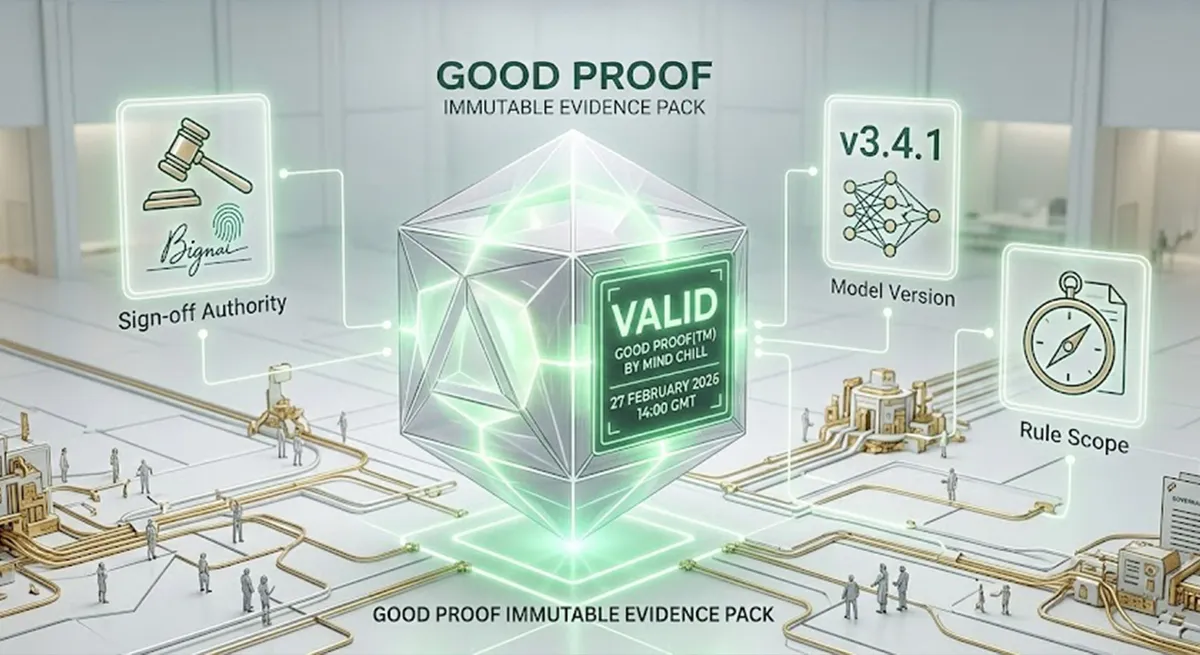
VALID
NEEDS_REFRESH
WITHDRAWN
NOT_VERIFIED
That is how you prevent stale restrictions becoming reputational failures.
It is also how you make appeals real:
A decision can move to WITHDRAWN without a week of cross-system archaeology.
3) Evidence Packs that survive hostile review
Statements of Reasons are not the evidence chain.
They are the narrative surface.
Good Proof™ produces a decision-time Evidence Pack built for:
appeals review
internal audit
regulator queries
legal defensibility
cross-region consistency review
communications escalation handling
It is designed around proof, not payloads, so you can defend decisions without oversharing sensitive internal methods by default.
We see lived-experience edge cases as a governance asset
Most Trust and Safety failures are not caused by the obvious cases.
They are caused by the weird ones:
cultural nuance and satire
vulnerable users and power dynamics
faith and identity edge cases
regional interpretation drift
intent that automation can’t infer reliably
patterns that look statistically reasonable but become socially explosive
This is why Mind Chill Guardians matter.
Guardians are not “extra reviewers.”
They are a structured way to surface lived-experience edge cases from diverse backgrounds and contexts, including the communities that most often absorb the fallout when enforcement goes wrong.
The practical value is not moral signaling.
It is operational risk reduction:
fewer recurring blind spots
earlier detection of pattern harms
better proportionality calibration
fewer viral “this is unfair” narratives that become regulatory narratives
Domain expertise in intent, not just policy text
Modern platform risk is often not “did it violate policy.”
It’s “what was the intent and context, and was the restriction proportionate.”
Guardians help surface the edge cases where intent matters most, then route those cases into structured rule improvements rather than one-off judgement calls.
The Guardian loop: edge cases become updates, not recurring incidents
Good Proof™ uses a structured loop so edge cases become policy updates, not recurring surprises.
Edge-case discovery
Guardian flags a novel scenario during review.
Escalation and multi-reviewer consensus
Pattern logged, clustered, and reviewed with clear consensus thresholds.
Policy or lane-rule update
Lane rules or escalation criteria amended, versioned, and scoped.
Regression testing
Edge case added to sampling and test suites to prevent repeat failures.
Change log entry
Recorded to the Good Proof Live Ledger so you can show what changed, when, and why.
This is governance you can demonstrate, not just describe.
The fastest way to start (and why it gets approved)
Here is what makes this “worth a meeting” for serious platform operators:
You can pilot it in 30 days in one lane, without rewriting your stack.
A 30-day pilot lane that proves value
Lane: One high-impact restriction action (for example ban, monetisation restriction, LIVE restriction, or high-risk visibility restriction) in one region.
Outputs:
scope-bound Stamp for that action class
Status Link semantics (VALID / NEEDS_REFRESH / WITHDRAWN / NOT_VERIFIED)
decision-time Evidence Pack for appeals and governance review
Success metrics:
reduced “rebuild the record” time in escalations
faster appeal resolution for the selected lane
fewer repeat edge-case incidents in that lane as regression tests accumulate
clearer, more consistent Statements of Reasons support because scope and versioning are explicit
This is not a new moderation system purchase.
It is a defensibility upgrade that reduces operational drag.
The PR angle: “defensible enforcement” becomes a trust claim
In 2026, a ban story can become a regulator story in one news cycle.